
Free online invoicing software
with KSeF support
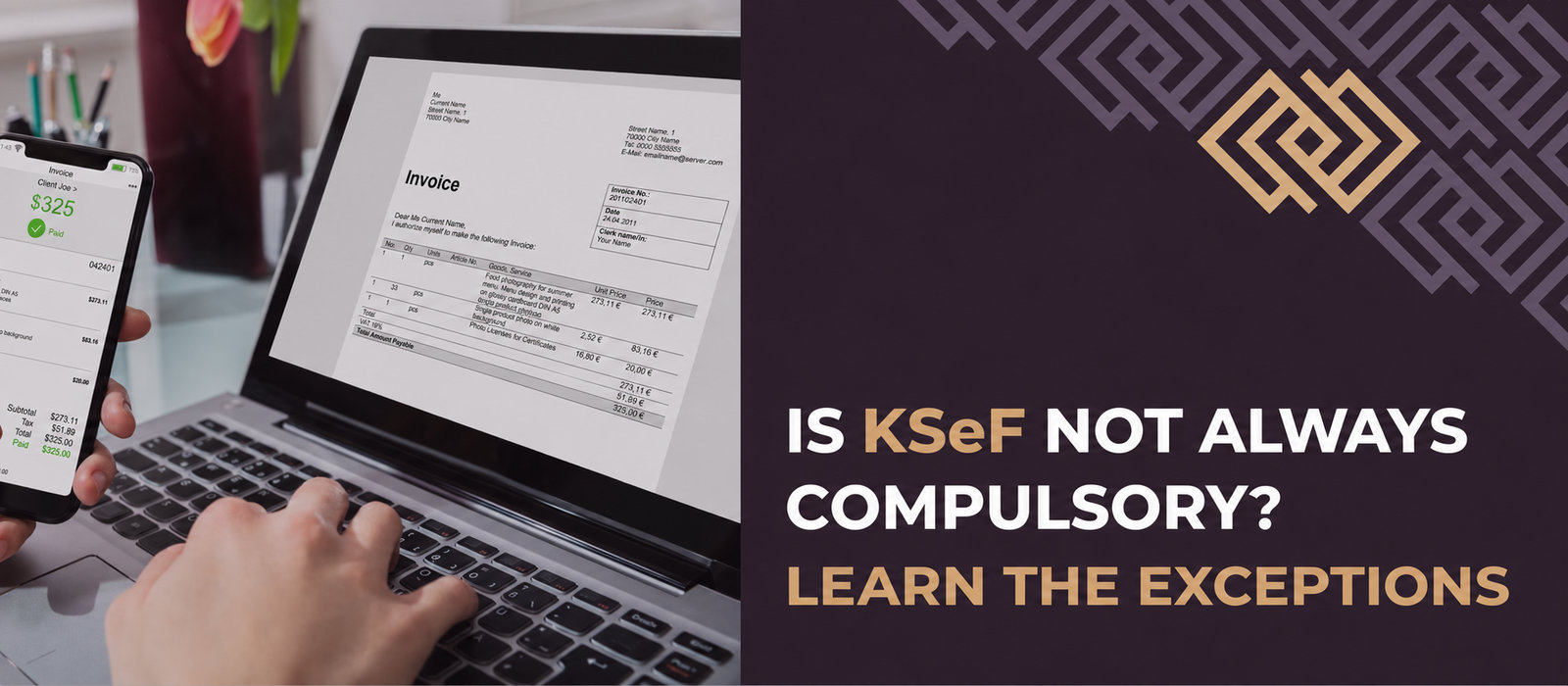
On 1 February 2026, the National e-Invoicing System became compulsory for some entrepreneurs operating in Poland. The e-invoicing obligation will extend to other companies in the coming weeks. However, mandatory KSeF does not apply to all invoices or all entities. In this article, we describe the most important exceptions.
The National e-Invoicing System – what is it and when must companies implement KSeF?
KSeF, the National e-Invoicing System, is a nationwide solution provided by the Ministry of Finance for issuing, receiving, sharing and archiving structured invoices, meaning invoices with a single predetermined template and format.
KSeF has already become compulsory for some of the largest companies operating in Poland. Entities with gross revenue exceeding PLN 200 million in 2024 became subject to it on 1 February 2026.
On 1 April 2026, the obligation to issue invoices in KSeF will also extend to smaller companies. Only entrepreneurs whose monthly gross revenue does not exceed PLN 10,000 will be able to use an exemption until the end of this year.

Accounting that understands your business
Leave your email address and receive guides supporting your business’s growth once a week

Mandatory KSeF – exceptions to the obligation to issue structured invoices
However, the VAT Act provisions concerning the National e-Invoicing System and imposing related obligations on entrepreneurs also provide exceptions to mandatory KSeF.
Although Article 106ga(1) of the VAT Act explicitly states that “Taxpayers are obliged to issue structured invoices using the National e-Invoicing System”, paragraph 2 of the same article lists invoices for which this obligation does not apply.
These are invoices issued:
- By entities with neither a business establishment nor a fixed establishment in Poland;
- By entities without a business establishment in Poland but with a fixed establishment here that does not participate in the supply of goods or services for which the invoice was issued;
- By entities documenting transactions under special schemes, such as:
- The non-Union scheme for certain services (described in Chapter 7 of Section XII of the VAT Act);
- The special scheme for international occasional passenger transport by road (described in Chapter 7a of Section XII of the VAT Act); o The special scheme for distance sales of imported goods (described in Chapter 9 of Section XII of the VAT Act);
- To purchasers of goods or services who are individuals not engaged in business activity (i.e. in B2C relationships);
- For appropriately documented supplies of goods or services specified by regulation by the minister responsible for public finance;
- By entities using the turnover-based VAT exemption for taxpayers established in another EU member state (the exemption described in Article 113a of the VAT Act).
In all these cases, under Article 106ga(3) of the VAT Act, invoices are issued electronically or on paper. There is therefore no obligation to issue structured invoices using the National e-Invoicing System. However, the absence of an obligation naturally still leaves the possibility of using KSeF voluntarily.
Interested in this article? Explore our tax advisory services and see how we can help:
Summary

Interested in this article?
Enter your email address and once a week you will receive practical materials and tips to help you grow your business.

Book a free consultation
Grow your business with accounting combined with advisory services:

or