
Free online invoicing software
with KSeF support
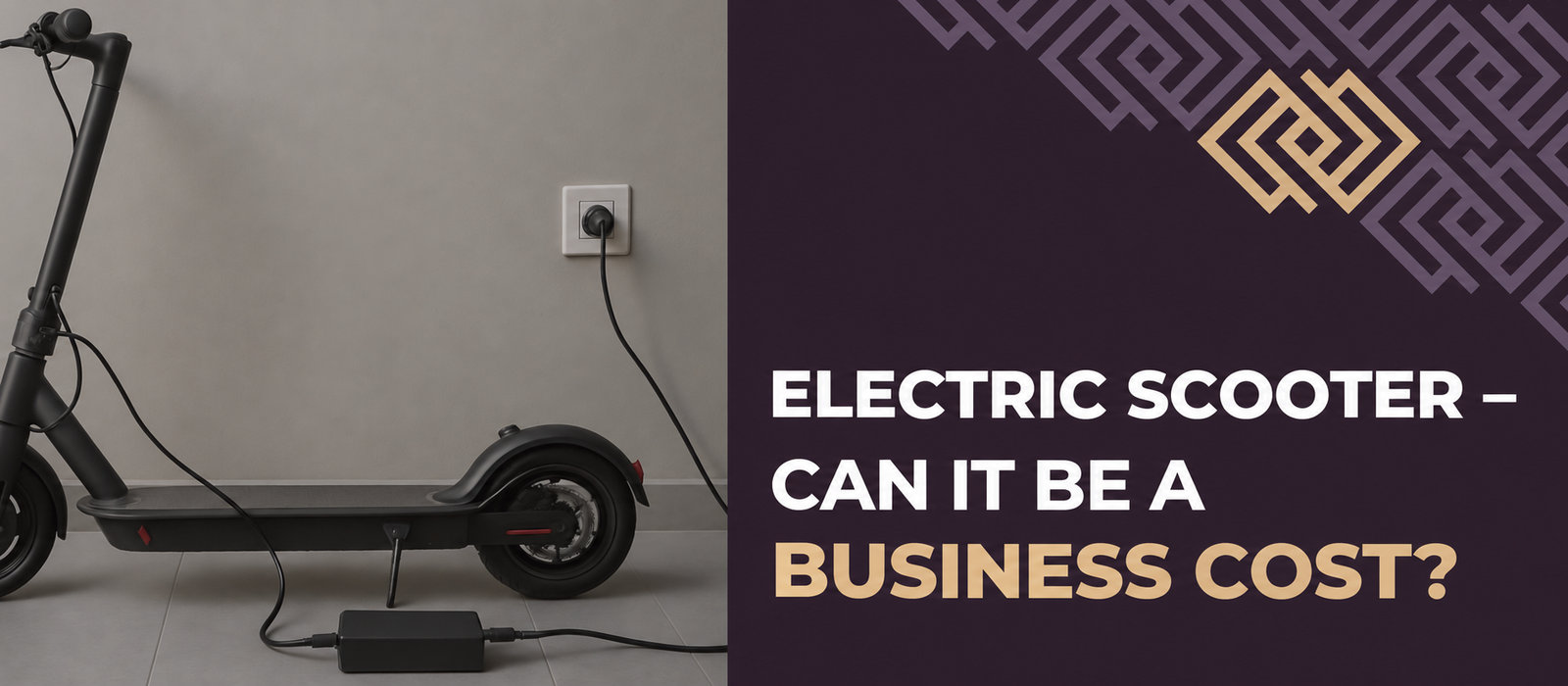
Recently, an electric scooter has become an excellent alternative to cars, bicycles and motor scooters. It undoubtedly helps people travel more efficiently in crowded cities. Can an entrepreneur’s purchase of one therefore be included in business costs?
What counts as a tax-deductible cost?
Under Article 22(1) of the Personal Income Tax Act, an expense incurred to earn revenue or maintain or secure a source of revenue may be treated as tax-deductible, except for expenses listed in Article 23.
Remember that, during a possible tax inspection, the entrepreneur must demonstrate the connection between the expense and the business. It is not always clear whether an expense is tax-deductible. In such cases, it is worth applying for an individual tax ruling.

Subscribe to our newsletter
Leave your email address and receive guides supporting your business’s growth once a week

An electric scooter is a personal transport device that can reach speeds of up to 25 km/h. Many entrepreneurs are therefore considering buying one. Can a company’s purchase of an electric scooter be tax-deductible?
Electric scooters are not on the closed list of expenses that cannot be deducted, and can be an excellent means of transport for commuting to one’s business or visiting clients and partners. They also help avoid rush-hour traffic. Thus, if using the scooter solely for business is justified and its purchase is properly documented with an invoice or receipt, it can generally be a business expense.
An individual ruling issued by the director of the National Tax Information service on 7 August 2019, reference 0112-KDIL3-3.4011.242.2019.2.TW, confirms that a scooter can be a tax-deductible cost. It states:
“(...) expenditure on purchasing a scooter used by the applicant solely for business purposes may be included directly in tax-deductible costs. It is therefore possible to recognise it in the month in which the electric scooter was purchased.”
Despite the favourable ruling, ensure that during a tax inspection the business scooter is not regarded as satisfying the personal needs of its owner or family members, which could lead the tax office to challenge the cost.
Because a scooter is not a passenger vehicle under the Road Traffic Code, its running costs need not be capped as car costs are. The associated expenses are therefore recognised in full.
Buying an electric scooter does not rule out owning a passenger car, or vice versa. What matters is a logical business justification for both means of transport – how and why each is used – so the expense is not challenged during an inspection.
Electric scooter – how should you classify the expense?
Generally, depending on how it is financed, its value and period of use, an electric scooter can be:
- entered in the fixed-asset register,
- entered directly as a tax cost,
- used under an operating or finance lease.
If the scooter meets the definition of a fixed asset, costs over PLN 10,000 (net for VAT taxpayers, gross for non-VAT taxpayers) and will be used for over a year, it should be entered in the fixed-asset register. Depreciation charges are then tax-deductible.
If the purchase value does not exceed PLN 10,000 (net for active VAT taxpayers, gross for others), it need not be entered in the fixed-asset register. If the taxpayer treats it as tax-deductible, the purchase is recorded in column 13, “Other expenses”, of the tax revenue and expense ledger.
Where the entrepreneur uses the scooter for business under an operating lease, the full lease instalments plus any handling fees and commissions shown on the lessor’s invoice may be included in business costs. Under an operating lease the equipment remains the lessor’s property until the lessee buys it out.
Under a finance lease, the scooter enters the fixed-asset register when the agreement is concluded. Monthly depreciation and the interest part of the instalment shown on the lessor’s invoice are then business costs.
If the scooter is purchased exclusively for taxable activity, the taxpayer may deduct all VAT on its purchase and running costs.
If this article interested you, explore our accounting services and see how we can help:
Our specialists can help you put this knowledge into practice.

Interested in this article?
Enter your email address and once a week you will receive practical materials and tips to help you grow your business.

Book a free consultation
Grow your business with accounting combined with advisory services:

or